
Your Tax Year End checklist for 2025/26

Are you missing out on valuable tax allowances?

  • Many high-earning individuals could be leaving money on the table, because they’re not fully utilising the tax allowances and reliefs available to them each tax year.
  • If you’ve already accumulated significant pensions and investments, there’s more to gain – and to protect – by leveraging every allowance and relief that’s available to you.
  • It’s vital to act in good time, ahead of the 2025/26 tax year end. The last day is 5 April.

Secure your no-obligation Tax Year End health check with an expert wealth adviser.

Let’s get started

Work through your checklist, to ensure you’re utilising every tax allowance and relief available to you.

Pensions

1. Maximise the use of your pension annual allowance: Contribute up to £60,000 to your pension. Note that tax relief on personal contributions is also restricted to the higher of 100% of earnings in the tax year, or £3,600.

2. Explore utilising unused annual allowances from the past three tax years through carry forward rules. You could, in theory, make a one-off contribution of up to £200,000, at a cost from as little as £110,000.

3. Review the total value of your pensions: Even post-Lifetime Allowance (LTA) abolition, consider whether you should grow your pension pot beyond £1 million, or save and invest elsewhere. An adviser can help you to determine the best course of action through sophisticated cashflow and net worth modelling. While you’re here, track down previous pensions to make sure you know the true overall value.

4. Leverage employer pension contributions: Ensure you’re maximising employer-matched contributions, and reduce taxable income through salary and bonus sacrifice.

5. Utilise your spouse’s allowance: If your spouse hasn’t used their annual allowance, or could carry forward from the previous three years, consider making contributions on their behalf.

6. Utilise your children’s allowances: Each child benefits from a £3,600 pension annual allowance – contribute up to £2,880 each year on their behalf and they’ll benefit from 20% ‘tax relief’ with a government top-up.

The value of an investment with St. James’s Place will be directly linked to the performance of the funds you select and the value can therefore go down as well as up.  You may get back less than you invested. 

The levels and bases of taxation, and reliefs from taxation, can change at any time.  The value of any tax relief is generally dependent on individual circumstances.

ISAs

7. Use-or-lose your ISA allowance: Contribute up to £20,000 to your ISA for tax-efficient growth and income.

8. Use-or-lose your spouse’s ISA allowance, also, up to £20,000.

9. Junior ISAs for children: Invest up to £9,000 per child, benefiting from tax-efficient growth for their future.

10. Consider using a Lifetime ISA: Benefit from a 25% government top-up on contributions up to £4,000, if you’re under 50 (must be opened before you turn 40).

Please note Lifetime ISAs are not available through St. James’s Place.

Investments

11. Capital Gains Tax (CGT) allowance: Utilise the annual exemption (£3,000 per person for 2024/25) by realising gains before 5 April.

12. ‘Bed and ISA’ strategy: Sell investments to use your CGT exemption, then repurchase them in an ISA so they’re ‘wrapped’ going forward.

13. Offset capital losses: Use previous losses to offset gains, reducing CGT liabilities.

The value of an ISA with St. James’s Place will be directly linked to the performance of the funds you select and the value can therefore go down as well as up.  You may get back less than you invested.  

The levels and bases of taxation, and reliefs from taxation, can change at any time.  The value of any tax relief is generally dependent on individual circumstances.

Income

14. Gift income to a spouse: Transfer income-generating assets to a lower-earning spouse to potentially reduce your overall tax liability – although such transfers must be on an ‘outright and unconditional’ basis.

15. Utilise your dividend allowance: Use the £500 tax-free dividend allowance before the tax year end.

16. Rental income optimisation: Deduct legitimate expenses, or transfer rental income to a spouse if advantageous.

Inheritance Tax

17. Use your annual gifting allowance: Give up to £3,000 per person tax-free this year, with an additional £3,000 carry-forward from the previous year if unused.

18. Small gifts exemption: Make unlimited gifts of up to £250 per recipient.

19. Wedding/ civil partnership gifts: Gift up to £5,000 to children, £2,500 to grandchildren, or £1,000 to others.

20. Use Trusts for larger gifts: Shelter assets from potential inheritance tax liabilities using trusts.

21. Make regular gifts out of surplus income: These should be made for a consistent amount and frequency – and be affordable. Above all, they should be thoroughly documented.

22. Consider a Life Cover Plan: Write a Life Cover Plan into Trust, to pay towards eventual IHT liabilities.

The levels and bases of taxation, and reliefs from taxation, can change at any time.  The value of any tax relief is generally dependent on individual circumstances.

Trusts are not regulated by the Financial Conduct Authority.

Charitable Giving

23. Maximise ‘Gift Aid’ donations: Claim income tax relief and reduce IHT liabilities by donating to charities.

24. Donate shares: Gift shares to charities to claim full income and CGT relief.

Tax Relief and Allowances

25. Marriage Allowance Transfer: Transfer up to 10% of your personal allowance to a lower-earning spouse.

26. Claim tax relief on professional fees: Deduct fees for professional memberships or subscriptions related to your job.

27. Check your Personal Savings Allowance (PSA) utilisation: Ensure interest income doesn’t exceed tax-free PSA thresholds (£1,000 for basic rate, £500 for higher rate, and zero for additional rate taxpayers).

28. Rent-a-Room Relief: Earn up to £7,500 tax-free by letting a furnished room in your home.

The levels and bases of taxation, and reliefs from taxation, can change at any time.  The value of any tax relief is dependent on individual circumstances.

Family and Education Planning

29. Tax-free childcare accounts: Contribute to an account to receive a government top-up of up to £2,000 per child.

30. School fee and university planning: Invest tax-efficiently to build funds towards your children’s or grandchildren’s education.

The value of an investment with St. James’s Place will be directly linked to the performance of the funds you select and the value can therefore go down as well as up.  You may get back less than you invested.  

The levels and bases of taxation, and reliefs from taxation, can change at any time.  The value of any tax relief is generally dependent on individual circumstances.

Other considerations

31. Maximise state pension contributions: Review your National Insurance record to fill gaps and maximise state pension entitlement; particularly following career breaks, maternity or long-term illness.

32. Defer income: Delay bonuses or dividends to the next tax year if advantageous for tax purposes.

33. Review your tax codes: Ensure your tax code reflects your current situation to avoid overpayments.

34. Optimise use of company benefits: Consider salary sacrifice schemes for pensions, electric cars, or cycle-to-work programmes.

35. Review offshore investments: Check compliance with UK tax rules for offshore investments and ensure tax efficiency.

36. Check how much cash you’re holding: Do you have too much, or not enough, available in cash? What interest rate are you earning on it? Consider using a cash management service to maximise your income on cash,* and spread across multiple institutions to maximise FSCS protection.

The value of an investment with St. James’s Place will be directly linked to the performance of the funds you select and the value can therefore go down as well as up. You may get back less than you invested. Equities do not provide the security of capital which is characteristic of a deposit with a bank or building society.

The levels and bases of taxation, and reliefs from taxation, can change at any time. The value of any tax relief is generally dependent on individual circumstances.

*Through SJP’s cash management service powered by Flagstone – please note this service is separate and distinct to those offered by St. James’s Place.

tax year end

The value of an investment with St. James’s Place will be directly linked to the performance of the funds selected and may fall as well as rise. You may get back less than the amount invested.

The levels and bases of taxation, and reliefs from taxation, can change at any time and are generally dependent on individual circumstances.

More about Pension Carry Forward

Explore Carry Forward in detail

You may be able to ‘Carry Forward’ unused Pension Annual Allowances from the previous three tax years. In 2022/23, the annual allowance was £40,000; it then rose to £60,000 for 2023/24, 2024/25 and 2025/26.

The maximum gross contribution you could make is £220,000. This assumes that you have been a member of a qualifying pension scheme for each of the past three tax years, and that you have not made any contributions. It also assumes you are not subject to annual allowance tapering, in any of the years, which can be applied to high earners.

Individuals with a ‘threshold income’ over £200,000 and an ‘adjusted income’ over £260,000 are subject to the tapered annual allowance. The reduction in allowance halts when ‘adjusted income’ exceeds £360,000, setting the annual allowance to a minimal £10,000 for pension savings that receive the full benefit of tax relief.

Broadly, ‘Threshold Income’ includes all taxable income received in the tax year, including rental income, bonuses, dividend, and other taxable benefits.  From this you deduct any personal pension contributions to personal pension schemes. ‘Adjusted income’ includes all taxable income plus any employer pension contributions and most personal contributions to an occupational pension scheme.

To benefit from tax relief on personal contributions you also need earnings in the current tax year of at least the value of the contribution.

An additional rate taxpayer could capitalise on tax relief at up to 45% on their pension contribution, meaning theoretically up to £99,000 tax relief could be available through Carry Forward before Tax Year End on 5 April. The net cost of a £220,000 contribution could be as little as £121,000.

An expert wealth adviser can detail precisely what tax relief may be available to you, based on your individual circumstances.

Any tax relief above the basic rate must be claimed via HMRC.

The levels and bases of taxation, and reliefs from taxation, can change at any time and are generally dependent on individual circumstances.

A new Capital Gains Tax (CGT) landscape

Solutions to mitigate CGT hikes

Capital Gains Tax UK rates increased last tax year, from 10% to 18% for lower rate taxpayers, and from 20% to 24% for higher and additional rate taxpayers. The rates for residential property remain at 18% and 24% respectively.

Each UK adult continues to benefit from an annual CGT exemption of £3,000. Beyond utilising your CGT exemption and your partner’s, you could work with an expert wealth adviser to examine whether Offshore Bonds offer a solution that is suitable for your individual circumstances.

Offshore investments can be really helpful for some investors; for example, if you’re expecting your tax rate to fall or you are planning to live outside of the UK at some point in the future. Our range of international investments offers a solution for investors who wish to invest regularly or by a lump sum, and provides access to a range of asset classes and currencies.

The value of an investment with St. James’s Place will be directly linked to the performance of the funds selected and may fall as well as rise. You may get back less than the amount invested.

The levels and bases of taxation, and reliefs from taxation, can change at any time and are generally dependent on individual circumstances.

Currency movements may also affect the value of investments.

Start planning now – invest later. Obtain a bespoke financial plan, tailored to your unique objectives.

Book A Conversation

Should you require more information or have particular questions, we invite you to contact us at your convenience.

Contact Us

Advanced protection strategies for high net worth individuals

Why protection isn’t a product – it’s a philosophy

Most successful individuals understand the value of investing, tax planning, and building wealth. But far fewer give the same care and attention to protecting it.

We often encounter high net worth individuals with portfolios worth millions – yet protection strategies that are fragmented, outdated, or insufficient. The issue isn’t affordability. It’s complexity. And the misconception that insurance is only for people with “less to lose.”

The reality is this: the more you have, the more you need to protect.

In this article, we explore the advanced protection strategies used by high-net-worth individuals to safeguard their wealth, ensure family continuity, and keep their businesses resilient.

Life Insurance structured for tax and control

Term life vs. Whole of life: Matching product to purpose

While most people are familiar with term life cover, many HNWIs require a combination of term and whole-of-life (WOL) policies to achieve different objectives:

  • Term cover: Useful for covering debts, children’s education, or business continuity during a defined period (e.g. until retirement or exit).
  • Whole-of-life cover: Critical for estate planning – ensuring liquidity to meet inheritance tax (IHT) liabilities.

Writing policies into trust

Individuals benefit from a nil-rate band of £325,000 on their estate, above which subject to other allowances being available, assets face inheritance tax (IHT) at up to 40%.

High earners often make the mistake of holding life policies in their own name, which brings the payout into their estate – and potentially into the IHT net.

The solution? Write policies into trust to keep them outside the estate, avoid probate delays, and give control over who receives what, when, and how.

The levels and bases of taxation, and reliefs from taxation, can change at any time. The value of any tax relief depends on individual circumstances.

Trusts are not regulated by the Financial Conduct Authority.

Save time – receive a no-obligation protection sufficiency assessment.

Book Your Conversation

Relevant Life Plans: Tax-efficient cover for directors and high earners

Relevant Life Plans (RLPs) are a highly tax-efficient way for employers (typically limited companies) to provide individual life cover for an employee, including directors. They’re especially attractive to high earners and owner-managed businesses looking for a cost-effective way to protect loved ones and extract value from the company.

A Relevant Life Plan is a term life insurance policy that provides a lump sum benefit to the insured’s family or nominated beneficiaries if they die (or are diagnosed with a terminal illness) during the policy term.

For company directors, high-earning employees, or partners in a firm, a Relevant Life Plan (RLP) is often a cornerstone of HNW protection planning. RLPs are issued into a discretionary trust, keeping proceeds outside the estate.

Trusts are not regulated by the Financial Conduct Authority.

Critical Illness Cover – but done correctly

Critical illness cover is often overlooked by high net worth individuals, who may believe their wealth alone provides sufficient protection. However, for affluent clients – especially those with dependents, complex financial structures, or lifestyle dependencies on active income – critical illness cover is not just a safety net; it’s a strategic wealth preservation tool.

Liquidity protection at a critical time

While HNWIs may have significant assets, those assets are often tied up in illiquid holdings – property, businesses, pensions, or investments that cannot be easily accessed or sold without penalty or delay. A tax-free lump sum from a critical illness policy provides instant liquidity without needing to disrupt investment strategies, crystallise capital gains, or make distress sales.

Protecting human capital

Many HNWIs are entrepreneurs, executives, or consultants whose ability to earn is tied to their health and cognitive function. A diagnosis of cancer, stroke, or a heart attack could halt their income-generating potential – even if temporarily. Critical illness cover acts as a monetisation of human capital, ensuring the individual and their family can maintain lifestyle, commitments, and responsibilities without compromise.

Offsetting opportunity costs and recovery time

The cost of a serious illness is not just medical – it includes:

  • Loss of earnings (particularly for self-employed/HNWIs with performance-linked income)
  • Private rehabillitation, or experimental therapies
  • Time away from business ventures, affecting future growth and compound returns

Critical illness cover can fund these without eroding long-term investment portfolios or derailing growth strategies.

Protecting leverage and legacy commitments

HNWIs often use geared strategies – leveraging property or investments – and are committed to legacy or intergenerational planning. A serious illness at the wrong time could force early liquidation of assets, undermine gifting strategies, or create unforeseen liabilities.

Critical illness payouts can:

  • Pay off loans or service interest during incapacity
  • Fund trust or IHT planning strategies without delay
  • Maintain life cover or pension contributions during recovery

Supporting family stability and dependents

For clients with children in private education, dependents abroad, or family members reliant on their oversight (e.g. elderly parents, disabled children), a critical illness diagnosis can ripple through their financial ecosystem. Having an immediate lump sum allows the family to bring in support, continue funding important commitments, or restructure life with minimal stress.

Business continuity and key person risk

If the HNWI is a business owner, their illness could trigger:

  • Business interruption
  • Loss of investor confidence
  • Buy-sell complications with co-directors
  • Staff or client attrition

Critical illness cover can provide capital for succession, share purchase, or continuity.

Tax-efficient structuring

Depending on how it’s set up, critical illness can be arranged in tax-efficient structures that reduce corporation tax and preserve personal allowances.

The levels and bases of taxation, and reliefs from taxation, can change at any time. The value of any tax relief depends on individual circumstances.

Trusts are not regulated by the Financial Conduct Authority.

Executive income protection and business continuity

HNWIs often have non-salary income (e.g., dividends, drawings, performance bonuses), making standard income protection inadequate or mispriced.

Solution: Executive Income Protection, which can be structured via a company to:

  • Cover a % of total remuneration, not just base salary
  • Be tax-deductible for the company
  • Provide ongoing cover during sabbaticals or international relocation (if structured correctly)

For entrepreneurs or partners, cover can be extended to:

  • Replace lost profits or revenues in the event of illness
  • Provide sick pay for multiple directors or key individuals

The levels and bases of taxation, and reliefs from taxation, can change at any time. The value of any tax relief depends on individual circumstances.

Key Person and Shareholder Protection

If you run or co-own a business, you are the business. Your loss could destabilise your team, clients, and profitability.

Key Person Insurance:

Covers financial loss from the death or serious illness of a key revenue generator or leader. Payouts can be used to:

  • Recruit replacements
  • Cover lost profits
  • Stabilise credit lines or investor confidence

Shareholder/Partnership Protection:

If a co-owner dies or becomes critically ill, what happens to their shares?

Solution: Cross-option agreements funded by life and/or critical illness cover allow surviving shareholders to buy out the deceased’s estate at fair value, keeping ownership within the firm and avoiding disputes.

Premium equalisation also ensures tax efficiency and fairness between shareholders.

Cross Option agreements may involve the referal to a service which is separate and distinct to those offered by St. James’s Place.

Trusts and legacy structuring

Using life insurance in estate planning

When structured correctly, life insurance is a powerful estate planning instrument – not only as a means to provide for heirs, but also as a way to protect the estate itself. For wealthy individuals and families, particularly those with complex asset structures (e.g. businesses, real estate portfolios, or international holdings), life insurance can solve several challenges that arise when passing wealth between generations. Many wealthy families use life insurance as a liquidity tool to fund estate tax liabilities, often via Discretionary Trusts. This ensures:

  • Rapid access to capital (outside probate)
  • No forced asset sales (such as property or business interests)
  • Equalisation between beneficiaries (e.g., if one child inherits a business and the others don’t)

For ultra-high-net-worth individuals with high net worth but illiquid or unpredictable income, premium financing is becoming increasingly popular. This involves:

  • Borrowing funds (often through referral to private banking solutions) to pay large policy premiums
  • Using the policy’s cash value and/or death benefit as security
  • Repaying the loan via the estate, policy proceeds, or other liquidity events

This preserves capital and investment returns, avoids disrupting cash flow or needing to liquidate high-performing assets, and allows for much larger policies than might be affordable with cash alone. However, it is a complex strategy involving interest rate risk, loan covenants, and insurer underwriting – so professional advice is essential.

Additional considerations

  • Gift of premiums: Regular premiums paid into a trust may be exempt from IHT if they qualify as normal expenditure out of income.
  • Business Relief: If certain business assets qualify for Business Relief, life insurance might not be needed for those – but it’s important to plan for assets that don’t qualify.
  • Generational planning: Life insurance can also be used to fund Legacy Trusts or Dynasty Trusts, ensuring wealth protection across multiple generations.
  • Expatriates: International clients may benefit from offshore life assurance policies, adding layers of tax efficiency across jurisdictions.

The levels and bases of taxation, and reliefs from taxation, can change at any time. The value of any tax relief depends on individual circumstances.

Trusts are not regulated by the Financial Conduct Authority.

Private medical and global protection

For internationally mobile clients or those with high expectations for healthcare, private medical insurance and international health plans are essential.

Plans may include:

  • Worldwide cover with no cap on cancer care
  • Direct billing for major hospitals
  • Concierge claims management
  • Optional cover for dependents, domestic staff or business employees

HNWIs also benefit from second opinion services, executive health screening, and genomic testing – all now available via advanced private healthcare packages.

Philanthropic and ethical protection planning

Increasingly, HNWIs want to align their protection strategies with their values, such as:

  • Naming charitable organisations in their trust beneficiaries
  • Using overfunded life policies to create legacy donations
  • Applying ESG filters to insurers or private medical providers

These choices can be embedded into broader philanthropy planning, often in tandem with donor-advised funds or family foundations.

Ready to create your protection strategy?

Let’s Get Started

SJP Approved 16/09/2025

Should you require more information or have particular questions, we invite you to contact us at your convenience.

Contact Us

The Inheritance Tax Escape Route

Your complete guide to preserving family wealth for 2025/26

How high‑earning families and business owners can build and preserve wealth across generations – with practical steps you can take this tax year.

With inheritance tax (IHT) thresholds frozen until at least 2030 and new pension tax rules taking effect from 2027, many families are asking the same question:

“Do I need to leave the UK to protect my wealth?”

The good news: you don’t. There are multiple estate planning strategies available that can significantly reduce or even remove an eventual IHT liability – without changing your residency or lifestyle.

Read this 1-min snapshot first

If your total estate could exceed £500k+ as an individual, or £1m+ as a couple, you’re in inheritance tax (IHT) territory. If you’re around £2m+, decisions about lifetime gifts, trusts, business relief and pensions will materially alter your family’s eventual outcome. Here’s the fast path:

Write/Review your Will (and Letters of Wishes) and Lasting Powers of Attorney.

Map out your estate: assets, liabilities, how they’re owned (sole/ joint/ trust/ company), and your domicile/ residence status.

Use allowances today: £3,000 annual exemption, wedding/ civil ceremony gifts, small gifts, and – the most powerful – regular gifts out of surplus income.

Plan around the £2m threshold: keeping your estate below the Residence Nil-Rate Band (RNRB) taper can increase the tax‑free amount that passes with the family home.

Protect business and farm assets: review eligibility for Business Relief (BR)/ Agricultural Property Relief (APR), as well as the reforms to these reliefs from April 2026.

Re‑think pensions: with most pensions facing IHT from April 2027, adjust nominations, drawdown plans, and wrapper strategy to avoid double‑tax traps.

Fund the bill: if you can’t (or don’t want to) gift enough, consider whole‑of‑life insurance written in trust and pay premiums from surplus income.

Consider structures: trusts (bare/ IIP/ discretionary, loan trusts, discounted gift trusts) and Family Investment Companies (FICs) to control, protect and direct wealth.*

Charity: leave ≥10% of the net estate to charity to reduce IHT from 40% to 36%.

Keep records: gift logs, income vs expenditure evidence, trust paperwork, valuations, ownership statements, and a family “financial map”.

The levels and bases of taxation and reliefs from taxation can change at any time. Tax relief is dependent on individual circumstances.

Wills as well as Trusts are not regulated by the Financial Conduct Authority.

*Please note that advice in this area will necessitate the referral to a service that is separate and distinct to those offered by Apollo Private Wealth or St. James’s Place.

What’s changed and what’s coming

UK resident non‑domiciled individuals & IHT scope: from 6 April 2025, the UK has moved toward a residence‑based approach for IHT scope. Transitional rules may apply, and planning is essential if you have overseas assets.

Business & Agricultural Property Relief reforms: from 6 April 2026, BR/ APR will be modernised – including a £1m per‑person allowance at 100%, with only 50% relief above that, plus holding‑period and listing clarifications, and separate allowances for trusts/estates.

Pensions: from 6 April 2027, most unspent pensions are scheduled to be brought inside your estate and face IHT. This creates potential double tax alongside Income Tax on beneficiaries on the net proceeds.

With these major changes it is absolutely critical that you review your estate planning as soon as possible.

The levels and bases of taxation and reliefs from taxation can change at any time. Tax relief is dependent on individual circumstances.

Arrange your no-obligation estate planning conversation with an expert wealth adviser

Select date and time

The 11 fundamental principles to mitigating unnecessary inheritance tax eroding your family’s wealth

Principle 1. How IHT works (2025/26)
  • Standard rate: 40% above the available Nil‑Rate Band (NRB) and Residence Nil‑Rate Band (RNRB).
  • NRB: £325,000 per individual, generally transferable between spouses/civil partners.
  • RNRB: up to £175,000 per individual when leaving a qualifying residence to direct descendants. Unused RNRB is transferable. There’s a downsizing addition if you’ve sold, gifted or downsized.
  • RNRB taper: the RNRB is reduced by £1 for every £2 that the estate exceeds £2,000,000. Importantly, the estate value for taper ignores BR/ APR and similar reliefs (so you can’t “taper‑proof” via BR/ APR alone).
  • Spouse/civil partner exemption: generally unlimited on transfers between UK‑domiciled spouses/ civil partners.
  • Charity: leave ≥10% of the net estate to charity, and the IHT rate on the rest drops from 40% to 36%.
  • When is IHT paid? Typically due by the end of the sixth month after death; some assets allow the option to pay by instalments. Probate is usually granted after IHT is settled, so it’s necessary to plan liquidity.

Lifetime transfers

  • Potentially Exempt Transfers (PETs): outright gifts to individuals become fully exempt if you survive 7 years. Taper relief reduces tax on failed PETs in excess of any available nil rate band after year 3.
  • Chargeable Lifetime Transfers (CLTs): gifts to most trusts are CLTs and can attract 20% lifetime IHT above your available NRB, with possible further tax if you die within 7 years.
  • Gifts with Reservation (GWR): if you keep some form of benefit (e.g. stay living in the gifted home rent‑free), the asset remains in your estate. Pre-Owned Asset Tax (POAT) may also apply to certain arrangements.

The levels and bases of taxation and reliefs from taxation can change at any time. Tax relief is dependent on individual circumstances.

Principle 2. Mapping your estate (so you can plan with it)

Build an inventory:

  • Property: main home, other UK/ overseas property; ownership (joint tenants/ tenants in common), mortgages, SDLT history.
  • Pensions: DC/ DB values; death benefit nominations; age 75 considerations; current drawdown; protected tax‑free cash; uncrystallised amounts.
  • Investments & cash: ISAs, GIAs, bonds, AIM shares; premium bonds; crypto; private equity and other investments.
  • Business interests: shareholdings, partnerships/ LLPs, carried interest; qualifying trading status; excepted assets.
  • Trust interests: you as settlor/ trustee/ beneficiary; type of trust; assets; appointment powers; 10‑year/exit charge cycle.
  • Insurance: policies, owners, lives assured; in trust?; beneficiaries?
  • Loans: intra‑family loans, loan trusts; director’s loans
  • Liabilities: mortgages, personal loans, guarantees, IHT loans, POAT charges.
  • Domicile & residence: your current status and history; exposure of overseas assets; treaty positions.

Outputs: (a) estimated taxable estate at death, (b) expected IHT liquidity (cash to pay), and (c) target actions this tax year.

An expert Private Wealth Adviser will help you gather this information and ‘model’ it, with various scenarios to show potential liabilities and mitigation actions.

The levels and bases of taxation and reliefs from taxation can change at any time. Tax relief is dependent on individual circumstances.

Wills as well as Trusts are not regulated by the Financial Conduct Authority.

Principle 3. The £2m question: Restoring a tapered RNRB

If your estate exceeds £2m, your RNRB can reduce to zero. Practical ways to manage the estate value at death:

  1. Time‑sequenced gifting
    • Use annual/ small/ wedding exemptions now.
    • Establish regular gifts out of surplus income (document the pattern and that your lifestyle is unaffected).
    • Consider larger PETs early to start the 7‑year clock.
  2. Charitable bequests
    • Calibrate a residuary gift to charity so that your adjusted estate drops below £2m while also unlocking the 36% rate.
  3. Trust strategies
    • Loan trusts/ discounted gift trusts — retain access to an income stream while moving capital growth outside your estate, subject to CLT/ GWR/ POAT rules.
  4. Business & agricultural planning
    • BR/APR relief does not reduce the estate value for RNRB taper, but lifetime planning may still reduce your taxable estate and improve control.
  5. Pensions & wrappers
    • Historically, pensions sat outside IHT; with pensions scheduled to face IHT from April 2027, revisit the balance between ISAs, GIAs and pensions and your drawdown plan.

Worked example (simplified): Total estate £2.3m; home £900k left to children; couple with full transferable NRB/ RNRB. Because the estate exceeds £2m by £300k, the RNRB is reduced by £150k. Bringing the estate down to £1.99m (via gifts/ charity) can restore up to £350k of additional tax‑free band for the couple.

The levels and bases of taxation and reliefs from taxation can change at any time. Tax relief is dependent on individual circumstances.

Trusts are not regulated by the Financial Conduct Authority.

Principle 4. Lifetime gifting that actually works
  1. Use the easy wins first
    • Annual exemption: £3,000 per donor per tax year (can carry forward one prior year if unused).
    • Small gifts: £250 per recipient per tax year (cannot combine with the £3,000 exemption to the same person).
    • Wedding/ civil ceremony: up to £5,000 to a child, £2,500 to a grandchild/ great‑grandchild, £1,000 to others.
  2. The most powerful – regular gifts out of surplus income
    • Gifts must be from income, regular/ normal, and not reduce your standard of living. Keep meticulous records (income/ expenses schedule, minutes/ letters, bank statements).
  3. PETs vs CLTsPETs (to individuals)
    • no lifetime tax, fully exempt after 7 years; taper relief applies on failed PETs in excess of any available nil rate band after 3 years (tax on the gift, not the estate).
    • CLTs (to most trusts): may trigger 20% lifetime IHT above NRB; further charges if death within 7 years. Trusts within the Relevant Property Regime may face 10‑year and exit charges.
  4. Trap‑dodgingGWR/POAT
    • Don’t keep using what you’ve “given away” (e.g. living in a gifted home) without paying full market rent; beware asset “share‑and‑stay” schemes.
    • 14‑year look‑back: earlier CLTs can reduce the NRB available against later gifts, increasing potential tax if you die within 7 years of the later gift.
  5. Record‑keeping pack (we’ll help you set up)
    • Gift log (date, recipient, amount, exemption used, cumulative totals)
    • Income vs expenditure statement (evidence for the “surplus income” rule)
    • Valuations and letters of intent/wishes

The levels and bases of taxation and reliefs from taxation can change at any time. Tax relief is dependent on individual circumstances.

Trusts are not regulated by the Financial Conduct Authority.

Principle 5. Trusts: Control, protection and precision
  1. Common trust types
    • Bare trust: simple, assets belong absolutely to the beneficiary at age 18 (16 in Scotland); gifts are PETs.*
    • Interest in Possession (IIP): named beneficiary has a right to income; can be pre‑ or post‑March 2006 with different IHT treatments.*
    • Discretionary trust: trustees decide who benefits and when; offers control/protection; falls under the Relevant Property Regime (RPR).*
    • Vulnerable beneficiary trusts: special tax treatment where conditions met.*
  2. Charges under RPR
    • Entry (usually CLT at up to 20% over NRB), 10‑year charges (up to 6% of value above NRB), and exit charges when capital leaves.
  3. Popular planning structures
    • Loan trust: you lend a lump sum to a trust; growth accrues outside your estate, while the loan remains repayable to you (no immediate gift for IHT, but loan forms part of your estate).*
    • Discounted Gift Trust (DGT): you gift into a trust but retain a fixed, actuarially‑valued income stream; the actuarial “discount” can reduce the initial CLT/GWR exposure.*
    • Life assurance in trust: Explained in greater detail in Principle 8.
  4. When trusts help most
    • You want control over timing/ quantum of distributions, or to protect beneficiaries (creditors, divorce risks, addiction, vulnerability).
    • You’re comfortable with trustee responsibilities, reporting, and charges.

The levels and bases of taxation and reliefs from taxation can change at any time. Tax relief is dependent on individual circumstances.

Trusts are not regulated by the Financial Conduct Authority.

*Please note that advice in this area will necessitate the referral to a service that is separate and distinct to those offered by Apollo Private Wealth or St. James’s Place.

Principle 6. Business & Agricultural Property Relief (BR/ APR)
  1. Today’s position (high‑level)
    • BR can provide 100% or 50% relief from IHT on shares in unlisted trading companies, interests in a trading partnership, or business assets used in a qualifying trade. Certain excepted assets may not qualify. Shares on certain junior markets may qualify depending on the rules.
    • APR can relieve the IHT value of qualifying agricultural property.
  2. Reforms from 6 April 2026 (headline points)
    • A new £1,000,000 per‑person allowance for the combined value relieved at 100% across APR and BR. Value above the allowance receives 50% relief.
    • Shares admitted to trading on certain recognised stock exchanges designated as “not listed” will receive 50% relief (not 100%).
    • Qualifying periods and conditions will be modernised/ clarified, and trusts/ estates will have their own allowances.
  3. What to do now
    • Audit eligibility of business/ farm assets and any AIM/ quoted exposures.
    • Consider timing of transactions, restructures, or succession ahead of April 2026.
    • Ensure excepted assets are minimised and trading tests are satisfied.

The levels and bases of taxation and reliefs from taxation can change at any time. Tax relief is dependent on individual circumstances.

Trusts are not regulated by the Financial Conduct Authority.

Principle 7. Pensions and the 2027 IHT change
  1. Position until April 2027 (simplified)
    • Currently, most unused DC pensions do not form part of the estate for IHT.
    • Income tax applies to beneficiaries’ withdrawals if death occurs after age 75; pre‑75 deaths can be tax‑free (subject to rules and timing).
  2. From 6 April 2027 (subject to legislation)
    • Most unused pension funds are scheduled to be included for IHT.
    • Spouse/ civil partner exemptions continue for death benefits paid to them.
    • This creates a potential double‑tax effect (IHT at death plus Income Tax on the net proceeds when beneficiaries draw the fund), producing very high effective rates for some families.
  3. Planning actions
    • Refresh nominations (make sure trustees have clear directions, and review expression of wishes wording).
    • Consider drawing part of the tax‑free Lump Sum Allowance and using it in‑life (spending, gifting, or funding insurance premiums) where appropriate.
    • Balance wrappers: re‑assess the trade‑off between keeping wealth inside pensions vs. drawing and moving to ISAs/ GIAs/ trusts/ FICs.
    • Integrate pension planning with your £2m RNRB taper strategy and overall IHT liquidity plan.

The levels and bases of taxation and reliefs from taxation can change at any time. Tax relief is dependent on individual circumstances.

Trusts are not regulated by the Financial Conduct Authority.

Principle 8. Life Cover written into Trust to help meet a liability

If you have surplus income and want to retain capital (or can’t gift enough), consider a guaranteed whole‑of‑life policy written in trust to create liquidity for heirs.

  1. Why trust‑own the policy?
    • Keeps the sum assured outside your estate.
    • Pays before probate, giving executors cash to meet IHT and other costs.
  2. Best practice
    • Pay premiums from surplus income (documented) where possible to avoid gifts counting against your NRB.
    • Review joint life, second‑death vs. single life arrangements; consider waiver of premium options.
  3. Illustrative cost
    • As a reference point, a joint life, second‑death guaranteed whole‑of‑life for age‑65 non‑smokers with £400,000 sum assured can be c. £6k–£7k p.a. (provider‑ and underwriting‑dependent). Your actual premium will vary.

The levels and bases of taxation and reliefs from taxation can change at any time. Tax relief is dependent on individual circumstances.

Trusts are not regulated by the Financial Conduct Authority.

Principle 9. Charitable giving

Leave ≥10% of your net estate (the “baseline amount”) to charity and your IHT rate can drop to 36% on the remainder.

Consider donor‑advised funds or charitable legacies via Will; you can also structure lifetime gifts (with Gift Aid where appropriate) to reduce the eventual estate.

The levels and bases of taxation and reliefs from taxation can change at any time. Tax relief is dependent on individual circumstances.

Principle 10. Domicile, residence and overseas assets

From 6 April 2025, the UK has shifted to a residence‑based approach for the scope of IHT on worldwide assets, with transitional rules. Long‑term UK residence can bring overseas assets into the IHT net after a qualifying period.

If you have non‑UK assets, review exposure and treaty interactions; consider excluded property trusts and timing where appropriate (specialist advice essential).

The levels and bases of taxation and reliefs from taxation can change at any time. Tax relief is dependent on individual circumstances.

Principle 11. Deeds of Variation (DoV)

Within 2 years of death, beneficiaries may vary an inheritance so they pass to others (including charity or trusts) and be treated for IHT/ CGT as if made by the deceased.

This can:

  • Restore RNRB by redirecting assets.
  • Reduce the overall IHT rate to 36% via charitable legacies.
  • Implement trusts where the Will didn’t.

All affected parties must agree; and we would refer you for legal advice.*

*Involves the referral to a service that is separate and distinct to those offered by St. James’s Place.

The levels and bases of taxation and reliefs from taxation can change at any time. Tax relief is dependent on individual circumstances.

Trusts are not regulated by the Financial Conduct Authority.

Pulling it together: Three mini case studies

A) Couple, estate £2.3m (home £900k), children as heirs

Goals: keep the family home; minimise IHT; keep flexibility.

  • Annual/small gifts and regular gifts out of income documented.
  • £60k charitable residuary legacy calibrated to bring estate below £2m at second death, to restore combined RNRB.
  • Loan trust established; growth now outside estate.
  • Whole‑of‑life policy £400k in trust funded from surplus income to create liquidity at second death.

The levels and bases of taxation and reliefs from taxation can change at any time. Tax relief is dependent on individual circumstances.

Trusts are not regulated by the Financial Conduct Authority.

B) Entrepreneur with trading company and AIM portfolio

Goals: succession to children; use reliefs; prepare for 2026 reforms.

  • Audit trading status/ excepted assets; rebalance AIM exposures mindful of 50% relief treatment changes post‑2026.
  • Pass controlling shareholding to family trust with staged appointments; equalise estates between spouses.
  • Update Wills to capture BR/ APR efficiently.

The levels and bases of taxation and reliefs from taxation can change at any time. Tax relief is dependent on individual circumstances.

Trusts are not regulated by the Financial Conduct Authority.

C) Widow with £1.7m pension + £600k ISA/ GIA

Goals: family provision with simplicity; aware of 2027 pension change.

  • Review beneficiary drawdown vs. lump sum; consider partial crystallisation and tax‑free cash gifting.
  • Increase ISA funding; consider charity legacy to reduce rate to 36%.
  • Evaluate whole‑of‑life in trust to fund residual IHT.

The levels and bases of taxation and reliefs from taxation can change at any time. Tax relief is dependent on individual circumstances.

Trusts are not regulated by the Financial Conduct Authority.

Your next 90 days (action list)

  1. Estate inventory and ownership map (Principle 2).
  2. Will and LPAs review; add letters of wishes (trusts/guardianship guidance).
  3. Set up gift log and begin surplus income gifting (documented).
  4. Decide on RNRB restoration approach if near/ over £2m (gift/ charity/ trust path).
  5. Pensions: update nominations; model drawdown vs. wrapper relocation ahead of 2027.
  6. BR/APR assets audit; plan around April 2026 reforms.
  7. Explore trusts if control/protection needed.
  8. Obtain quotes for a whole‑of‑life policy in trust funded from surplus income.
  9. Build the IHT liquidity plan and executor instructions.
  10. Schedule regular reviews; update on life events (property sales, business exits, windfalls).


An expert Private Wealth Adviser will help you put this plan into action.

Protecting your wealth from the taxman can be harder than creating it – but with early, structured planning and expert guidance, you can give your family the freedom, control and security you want for them. If any of this resonates, we’ll turn this into a personal plan and do the heavy lifting for you.

The levels and bases of taxation and reliefs from taxation can change at any time. Tax relief is dependent on individual circumstances.

Wills as well as Trusts are not regulated by the Financial Conduct Authority.

Arrange your no-obligation estate planning conversation with an expert wealth adviser

Select date and time

SJP Approved 11/09/2025

Should you require more information or have particular questions, we invite you to contact us at your convenience.

Contact Us

Avoiding the Retirement Tax Trap

A high net worth guide to investing for retirement; then drawing down tax efficiently

How high‑earning families and business owners can build wealth in anticipation of an early, affluent and tax-efficient retirement.

The retirement tax trap is straightforward: paying more tax than necessary by drawing the wrong money, from the wrong places, at the wrong time. For high net worth households this could be real money lost every year, compounding across decades and eroding legacies.

This guide is built to be your operational handbook. It explains how to:

  • Map your net-of-tax cashflow and direct funds to the right savings and investment wrappers;
  • Use ISAs, Pensions, GIAs, Onshore/Offshore Bonds and Trusts together – not in isolation;
  • Capitalise on today’s tax allowances and reliefs to invest more tax-efficiently (like the pension annual allowance of up to £60,000, and the removal of the Lifetime Allowance charge);
  • Sequence withdrawals to keep taxable income in low bands during retirement (while using allowances efficiently);
  • Plan for the 2027 pension‑IHT reforms to mitigate double taxation;
  • Deploy advanced moves (phased crystallisation, ‘bed & ISA’, bond segmentation) in a compliant and documented manner.

Practical benefit: for many HNW families, re‑sequencing and multi‑wrapper orchestration reduces annual tax leakage by £10k–£30k+ versus a single‑wrapper drawdown, often without reducing disposable income.

The value of an investment with St. James’s Place will be directly linked to the performance of the funds selected and may fall as well as rise. You may get back less than the amount invested.

The levels and bases of taxation, and reliefs from taxation, can change at any time. The value of any tax relief depends on individual circumstances.

Trusts are not regulated by the Financial Conduct Authority.

The retirement tax landscape at a glance

This section lists the key allowances and rules you will base every decision on, both for saving towards your retirement as well as when eventually drawing down from those investments in retirement.

Key income thresholds and allowances
  • Personal Allowance: £12,570 p.a. per person
    • Protect it! When total income exceeds £100k, the Personal Allowance is tapered by £1 for every £2; until it reaches £0 at £125,140 – an effective 62% marginal band when national insurance is factored in on top. Use pension contributions and other forms of salary sacrifice to avoid this cliff.
    • In retirement, use phased withdrawals to keep income-taxable drawdown below £100k each year.
  • Income tax bands (England & NI for 2025/26):
    • 20% basic rate; 40% higher rate; 45% additional rate.
    • In retirement, these determine the marginal cost of pension/ GIA/ bond events: small changes in taxable income can move you across bands with significant tax consequences.
  • Dividend allowance: £500 per person
  • Savings allowance per person:
    • £1,000 (basic rate taxpayer), £500 (higher rate taxpayer), £0 (additional rate taxpayer).

Practical tip: Always start withdrawal planning by listing all taxable sources (rental income; realised gains; dividend income; taxable pension income). Tax bands and allowances should form the ‘frame’ for sequencing.

The levels and bases of taxation and reliefs from taxation can change at any time. Tax relief is dependent on individual circumstances.

Capital Gains Tax (CGT)
  • Annual Exempt Amount: £3,000 per person
    • Where possible use it every year – it cannot be carried forward.
  • Rates (recently increased):
    • 18% within the basic rate band;
    • 24% for gains above the basic rate band.
    • That tightening increases the potential value that can be gained from annual CGT harvesting and ‘bed & ISA’ tactics.

What is ‘bed & ISA’?

  1. Sell the investment outside your ISA
    • You sell your shares, funds, or ETFs held in a general investment account (GIA) or similar.
    • This sale may realise a capital gain — but you can use your annual CGT allowance (£3,000 in 2025/26) to minimise or eliminate any tax liability.
  2. Repurchase the same investment inside the ISA
    • Using the proceeds from the sale, you immediately repurchase the same investment within your ISA (or choose something else entirely).
    • Once inside the ISA, all future growth and dividends are tax-free.

Practical tip: Small, repeated sales in General Investment Accounts – timed to use Annual Exempt Amounts and avoid income band creep – materially beat large once‑off disposals taxed at the higher CGT rate.

The value of an investment with St. James’s Place will be directly linked to the performance of the funds selected and may fall as well as rise. You may get back less than the amount invested.

The levels and bases of taxation and reliefs from taxation can change at any time. Tax relief is dependent on individual circumstances.

Pension allowances and crystallisation rules

Relevant primarily for Defined Contribution (DC) pensions

  • Annual Allowance: £60,000 (Tax relief is also limited to a maximum of 100% of relevant earnings in the year).
  • Tapered Annual Allowance:
    • Occurs where threshold income exceeds £200,000 and adjusted income exceeds £260,000
    • Allowance reduces by £1 for every £2 of adjusted income above £260,000, down to a minimum of £10,000.
  • Money Purchase Annual Allowance (MPAA): £10,000
    • Triggered if you flexibly access your pension; avoid accidental triggers!
  • Tax‑free pension cash/ Lump Sum Allowance (LSA):
    • 25% of the total value of your pensions, capped at £268,275
  • Lump Sum & Death Benefit Allowance (LSDBA): £1,073,100

Practical tip: After the removal of the Lifetime Allowance charge, one blunt cap was replaced with allowances and lump sum death‑benefit ceilings. Accessing the tax-free portion of your pension requires careful planning, as phased crystallisation can be more efficient than taking lump sums.

The value of an investment with St. James’s Place will be directly linked to the performance of the funds selected and may fall as well as rise. You may get back less than the amount invested.

The levels and bases of taxation and reliefs from taxation can change at any time. Tax relief is dependent on individual circumstances.

Individual Savings Accounts (ISAs)
  • ISA allowance: £20,000 per person
  • Growth and income on assets held within the ISA are free of Capital Gains Tax and Income Tax.
  • Withdrawals are tax free and do not count as taxable income – one of the most powerful levers in retirement sequencing.

Practical tip: Use ISAs to hold growth and yield assets that would otherwise generate taxable income in General Investment Accounts (GIAs) or pensions.

The value of an investment with St. James’s Place will be directly linked to the performance of the funds selected and may fall as well as rise. You may get back less than the amount invested.

The favourable tax treatment of ISAs may not be maintained in the future and is subject to changes in legislation.

Onshore & offshore investment bonds
  • 5% cumulative allowance per policy year: withdrawals up to 5% of capital investment (accumulative) are tax‑deferred (not tax‑free).
  • On a later chargeable event, gains are treated as savings income. ‘Top‑slicing’ relief may reduce the effective tax.
  • Segmentation (issuing multiple small bond segments) enables partial encashments without crystallising the entire bond.

Practical tip: Bonds are sequencing tools – excellent for smoothing when you want to avoid lifting marginal taxable income.

The value of an investment with St. James’s Place will be directly linked to the performance of the funds selected and may fall as well as rise. You may get back less than the amount invested.

The levels and bases of taxation and reliefs from taxation can change at any time. Tax relief is dependent on individual circumstances.

If the withdrawals taken exceed the growth of the Bond, the capital will be eroded.

Trusts and their charges

Discretionary trusts carry entry charges, 10‑year periodic charges (up to 6%), and exit charges – all complex, but invaluable where control and estate planning are jointly required with income management.

Practical tip: Use bonds in trust to provide family controlled distributions while preserving beneficiary tax allowances.

Trusts are not regulated by the Financial Conduct Authority.

The strategic pivot: Pensions & IHT from April 2027

From 6 April 2027, most unspent pensions and many pension death benefits will be included within estates for IHT purposes.

This is a structural change: the once‑automatic IHT shelter provided by pensions will no longer be universally reliable.

Practical tip: Planning that relied on “leaving wealth in pensions forever” should be re‑examined. Sequencing may shift towards partial de‑risking and movement into ISAs/ trusts/ bonds where appropriate.

The value of an investment with St. James’s Place will be directly linked to the performance of the funds selected and may fall as well as rise. You may get back less than the amount invested.

The levels and bases of taxation and reliefs from taxation can change at any time. Tax relief is dependent on individual circumstances.

State Pension

Often overlooked in drawdown, the New State Pension applies to men born on or after 6 April 1951, and women born on or after 6 April 1953.

New State Pension (full rate): £230.25 per week, or about £12,005 per year.

Qualifying years:

  • Minimum 10 years of National Insurance (NI) contributions or credits needed to receive any pension.
  • Full rate requires 35 years of qualifying contributions or credits.

Protected payments: If your earnings record from before April 2016 would give you a higher payout under legacy rules, you may receive that as a “protected payment” on top of the current full rate.

Deferral increases entitlement by ~1% every 9 weeks (~5.8% p.a.).

The “triple lock” policy guarantees the New State Pension will rise by the larger of: inflation (CPI), average earnings growth, or 2.5%. In 2025–26, the increase was 4.1%, based on average earnings growth from May-July 2024.

The government has launched the third review of the State Pension age, to determine whether pension age should be automatically linked to life expectancy, possibly raising it even further. The current plan already includes raising the age to 67 by 2027-2028 and to 68 by 2044-2046.

Arrange your no-obligation retirement planning conversation with an expert wealth adviser

Select date and time

The orchestration mindset: Principles and objectives

How high net worth households could avoid the retirement tax trap.

The objective: Provide for your target net-of-tax lifestyle, sustainably, while minimising total lifetime tax (Income Tax + CGT + IHT) and preserving estate optionality.

The levels and bases of taxation and reliefs from taxation can change at any time. Tax relief is dependent on individual circumstances.

Principle 1. Start with spend, not pots

Build a 10- to 30-year plan, that models the net income required each year, stress tested for market downturns and longevity. This should account for irregular outgoings too, such as travel, contributing to school fees, property works, gifting, and care contingencies.

An expert financial adviser will use sophisticated cashflow modelling software that considers a variety of scenarios.

Principle 2. Segment capital by tax behaviour

Define which savings and investment pots are tax‑free, tax‑deferred, taxable and trust/ legacy oriented.

  • Tax-efficient: ISA
  • Tax-deferred: Pensions & Bonds
  • Taxable but manageable: GIA
  • Plus, those which are Trust-based to offer control & IHT shaping

The value of an investment with St. James’s Place will be directly linked to the performance of the funds selected and may fall as well as rise. You may get back less than the amount invested.

The levels and bases of taxation, and reliefs from taxation, can change at any time. The value of any tax relief depends on individual circumstances.

Principle 3. Sequence withdrawals to preserve low-rate bands
  • Use allowance‑rich pots first and leave taxable pots to years where other income is low;
  • Keep taxable income inside lower bands/allowances;
  • Harvest CGT each year without eroding core capital;
  • Maintain optionality for later-life and estate outcomes.

The levels and bases of taxation and reliefs from taxation can change at any time. Tax relief is dependent on individual circumstances.

Principle 4. Split ownership of assets

Share key allowances between spouses;

  • Personal Allowance
  • CGT Annual Exemptions
  • Dividend allowances

…to avoid higher tax bands as individuals. Although, any transfer must be on an outright and unconditional basis.

The levels and bases of taxation, and reliefs from taxation, can change at any time. The value of any tax relief depends on individual circumstances.

Principle 5. Preserve optionality

Avoid locking all capital into illiquid or high-penalty structures.

For example, pensions generally cannot be accessed until age 55 (rising to age 57 in 2028), and now face potential double taxation inside estates for IHT purposes.

The value of an investment with St. James’s Place will be directly linked to the performance of the funds selected and may fall as well as rise. You may get back less than the amount invested. 

The levels and bases of taxation, and reliefs from taxation, can change at any time. The value of any tax relief depends on individual circumstances.

Principle 6. Annual discipline
  • Harvest allowances;
  • Move assets to ISAs when appropriate;
  • Re-sequence if income profile changes;
  • Crystallise gains;
  • Reset bond segments; and
  • Top up a 2-3 year cash bucket so markets don’t dictate tax timing.

Tax optimisation is allocation and timing: Think allocation (ISA vs GIA vs pension) and timing (year to year sequencing). For HNW households, a modest shift in timing often outperforms a risky, concentrated tax shelter.

Total-return beats income-only: Preferring high yields traps you in dividend tax bands and concentration risk. A total-return approach with controlled sales from the optimal wrapper gives cleaner tax and risk management.

The value of an investment with St. James’s Place will be directly linked to the performance of the funds selected and may fall as well as rise. You may get back less than the amount invested.

The levels and bases of taxation, and reliefs from taxation, can change at any time. The value of any tax relief depends on individual circumstances.

Wrapper-by-wrapper: Deep dive and pro moves

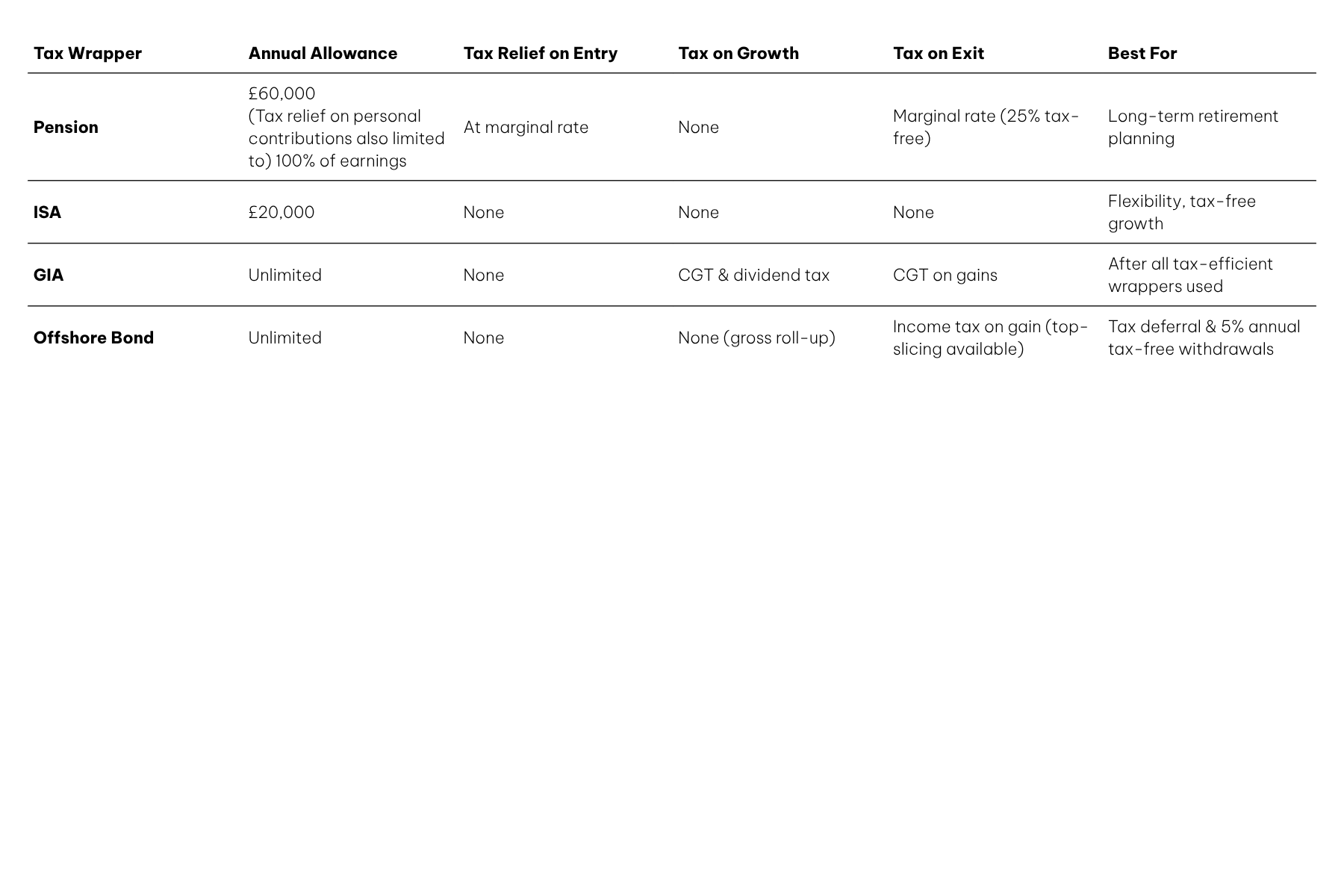
What each wrapper really does, and how to use them. These are the rules, tactical moves, common pitfalls and pro plays for each wrapper.

Pensions – the orchestration core

Core rules:

  • Up to 25% tax-free, but limited by LSA £268,275 (protections aside). Remainder taxed at your marginal rates.
  • Contributions: Annual Allowance £60k, taper from £260k adjusted income (min £10k). MPAA £10k if flexibly accessed.
  • Flexi-access drawdown vs UFPLS: both create taxable income beyond the tax-free element; beware Emergency (Month-1) tax on first payments; reclaim via P55/ P53Z/ P50Z.

What they do well:

  • Tax relief on eligible contributions;
  • Tax‑deferred compounding;
  • Structured death benefits (beneficiary rules).

Key constraints:

  • Taxable on withdrawal beyond PCLS/ LSA;
  • MPAA may restrict future contributions once flexible access is used;
  • PCLS subject to LSA cap;
  • 2027 IHT inclusion looms.

Pro moves:

  • Earning between £100–£125k? Combine pension contributions and other salary sacrifice to reclaim or preserve Personal Allowance (effective 62% marginal relief zone).
  • Phased crystallisation:
    • Crystallise small portions each year to realise up to 25% tax‑free cash (within LSA) and keep taxable income inside target bands.
    • Preferred to large UFPLS where MPAA or rate spikes may occur.
  • PCLS-only first draws (where legally feasible) to avoid MPAA trigger in the short term. Document carefully.
  • Pension contributions as tax-band management: for those near the PA taper band, an extra pension contribution or Gift Aid top‑up can reduce adjusted net income, restoring PA or reducing marginal rates. (Use with caution and model liquidity.)

Common mistakes:

  • Emergency tax shock on first draw; plan cash and reclaim promptly.
  • Taking a large UFPLS early, triggering MPAA or pushing into 45% band. Can trigger HICBC/ benefit cliffs for under-retirement-age households.
  • Failing to segment crystallisations, losing LSA advantage or incurring unnecessary income spikes.

The value of an investment with St. James’s Place will be directly linked to the performance of the funds selected and may fall as well as rise. You may get back less than the amount invested.

The levels and bases of taxation and reliefs from taxation can change at any time. Tax relief is dependent on individual circumstances.

ISAs – the retirement workhorse

Core rules:

  • Withdrawals are tax-free and don’t count as income for tax-band tests – ideal for smoothing income and avoiding higher-rate thresholds.
  • £20,000 p.a. use-it-or-lose-it allowance per person.

What they do well:

  • Tax‑free withdrawals;
  • Tax-efficient growth and income on investments within ISAs;
  • Do not count as taxable income;
  • Ideal for smoothing tax bands.

Pro moves:

  • Prioritise funding ISAs in accumulation years after covering tax‑efficient pension contribution needs.
  • Family pooling: two spouses = £40k p.a.
  • Bed & ISA‘ GIA assets each year to migrate yield/ growth into a tax-free silo.
  • Park high-yield or fast-growing assets inside ISA to silence tax drag.

Common mistakes:

  • Putting low‑growth or defensive assets into ISAs, while leaving high‑growth investments in pensions/GIA – match asset to wrapper strategically.

The value of an investment with St. James’s Place will be directly linked to the performance of the funds selected and may fall as well as rise. You may get back less than the amount invested.

The levels and bases of taxation and reliefs from taxation can change at any time. Tax relief is dependent on individual circumstances.

GIAs – taxable but flexible

Purpose:

Flexible, taxable accounts used for CGT harvesting, dividend management and bridging between tax‑sheltered pots.

Pro moves:

  • Annual CGT harvesting: Crystallise up to £3,000 p.p. every year. Split across spouses for double allowance.
  • Bed & spouse’ transfers: Shift gains to the spouse with lower rates or unused allowances (watch out for 30‑day/ share-matching rules to avoid wash sales).
  • Prefer funds with accumulation units where dividend stuffing would otherwise create tax drag.
  • Target dividends within the £500 allowance; progressively migrate surplus yield into ISAs.

The value of an investment with St. James’s Place will be directly linked to the performance of the funds selected and may fall as well as rise. You may get back less than the amount invested.

The levels and bases of taxation and reliefs from taxation can change at any time. Tax relief is dependent on individual circumstances.

Onshore & offshore investment bonds – mastering deferral

Purpose:

  • Create tax-deferred cashflow via the 5% cumulative allowance – useful when you want spending power without lifting taxable income;
  • Top-slicing relief may mitigate a large one-off encashment if held many years;
  • Assignments (to spouse/trust) normally no gain/ no loss – can shift future gains to different taxpayers/structures;
  • Useful in early retirement or when deterministic withdrawals are required.

Design tips:

  • Segment policies at outset (e.g., 10–100 segments) to allow partial encashment without crystallising the whole bond;
  • Match bond type to tax profile: onshore has a basic-rate credit; offshore maximises gross roll-up but gains are fully income-taxed when they arise.

Pro moves:

  • Segment large bonds into multiple policies/ segments to allow partial surrenders;
  • Use top‑slicing relief modelling when planning a large encashment;
  • Assign to spouse or trust as part of intergenerational planning (assignment usually non‑taxable).

Common errors:

  • Treating 5% as tax-free (it’s deferred); always model the eventual chargeable event with future expected income bands;
  • Large future chargeable events can collide with high-rate bands or Personal Allowance taper.

The value of an investment with St. James’s Place will be directly linked to the performance of the funds selected and may fall as well as rise. You may get back less than the amount invested.

The levels and bases of taxation and reliefs from taxation can change at any time. Tax relief is dependent on individual circumstances.

If the withdrawals taken exceed the growth of the Bond, the capital will be eroded.

Trusts – for control

Purpose:

  • Control, protection, and IHT management for surplus capital;
  • Ring‑fencing and bespoke distributions;
  • Useful when a retiree wishes to provide controlled family income without inflating personal taxable income.

Key charges:

  • Entry: 20% on value above available Nil-Rate Band (NRB) for discretionary trusts;
  • Periodic (10-year) charge: up to 6% above NRB;
  • Exit charges apply on capital appointments.

Where Trusts meet retirement income:

  • House surplus capital in trust (often using bonds) to deliver trustee-controlled distributions while ring-fencing from your personal bands/ means-tests.
  • Time trustee distributions around beneficiaries’ allowances (e.g., adult children in low bands).

Pro move:

  • Use trusts for pension death benefit holding where legislation permits (but seek legal advice).

Trusts are not regulated by the Financial Conduct Authority.

Obtain a no-obligation review of your retirement planning opportunities

Meet with an expert

Withdrawal sequencing playbook

Concrete algorithms and templates you can run each year, according to your household’s objectives.

An expert financial adviser will revisit your sequencing strategies each year using cashflow modelling; taking into account market fluctuations, tax allowances and reliefs, and your changing tax bands.

Template A: Keep taxable income ≤ basic-rate band
  1. ISAs first (withdraw tax‑free cash to meet most of the need).
  2. Bond 5% allowances next (tax deferred).
  3. GIA disposals up to CGT Annual Exemption.
  4. Pension taxable draw only to fill remaining PA/ basic band headroom.

This maximises tax‑free draw, defers taxable draws until necessary, and avoids creeping into 40/ 45% income tax territory.

The value of an investment with St. James’s Place will be directly linked to the performance of the funds selected and may fall as well as rise. You may get back less than the amount invested.

The levels and bases of taxation and reliefs from taxation can change at any time. Tax relief is dependent on individual circumstances.

If the withdrawals taken exceed the growth of the Bond, the capital will be eroded.

Template B: Materially zero-tax year
  1. ISAs first;
  2. Bond 5% allowances next (tax deferred);
  3. Pension up to Personal Allowance only;
  4. Harvest CGT Annual Exemption in GIA, but avoid creating dividend income beyond the £500 allowance.

The value of an investment with St. James’s Place will be directly linked to the performance of the funds selected and may fall as well as rise. You may get back less than the amount invested.

The levels and bases of taxation and reliefs from taxation can change at any time. Tax relief is dependent on individual circumstances.

If the withdrawals taken exceed the growth of the Bond, the capital will be eroded.

Template C: Estate-centric pre-2027 reposition

Goal: Re‑weight pension‑heavy estates to reduce 2027 IHT exposure, without spiking marginal tax rates.

  1. Cash & ISA top ups;
  2. Phased crystallisation of smaller pension tranches to preserve PA and basic rate (not UFPLS lumps) to re-weight gradually from pension to ISA/ bond/ trust;
  3. GIA to fund bed & ISA over multiples years;
  4. Onshore bond assignment to trust where continuity of control is needed;
  5. Life cover in trust to insure IHT if immediate migration impossible.Note: model run‑rate impact carefully; acting too quickly may crystallise gains or incur large income tax;
  6. Maintain a cash buffer (2–3 years) to avoid forced selling in down markets, preserving tax control into 2027+.

Important: Your financial adviser should model the run‑rate impact carefully; acting too quickly may crystallise gains or incur large income tax.

Implementation algorithm (annual):

  1. Forecast the next 24 months of required net spending (base and irregular);
  2. Project all expected non‑portfolio income (state pension, rental, interest);
  3. Run the sequencing template to meet net spend, while keeping taxable income within parameters;
  4. Update ISA/ CGT harvest/ segment bond decisions for each tax year;
  5. Rebalance, migrate high‑return assets into ISAs if room, and reset bond segments.

The value of an investment with St. James’s Place will be directly linked to the performance of the funds selected and may fall as well as rise. You may get back less than the amount invested.

The levels and bases of taxation and reliefs from taxation can change at any time. Tax relief is dependent on individual circumstances.

Example case studies

These examples show the numerical effect of sequencing. All examples are simplified and illustrative, will not be suitable for everyone and do not constitute advice. An expert financial adviser can show more precise outcomes through cashflow modelling. Investment risk, sequencing, spend patterns and wrapper history will alter outcomes.

Example A: £80,000 lifestyle with minimal/ zero tax

Two spouses age 60 and 58 target £80,000 annual expenditure.

Asset breakdown:

  • Pensions: £900k (uncrystallised)
  • ISAs: £450k
  • GIAs: £500k
  • Offshore bond: £300k (10 segments)
  • Cash: £50k

Annual drawdown plan (year 1):

  • Withdraw £40,000 from ISAs (untaxed)
  • Withdraw £15,000 from offshore bond (5% allowance of £300k, tax deferred)
  • Each crystallise pension income equal to Personal Allowance of £12,570, using PCLS to fund the tax‑free portion (zero taxable income)
  • Realise £6,000 in gains from GIA (utilising annual exemption)
  • Earn dividends up to £1,000 (utilising allowances); migrating high-yield positions into ISAs over time.

Net result:

~£80k cash flow with negligible/ zero current-year income tax; no CGT; bond withdrawals deferred; pensions largely untouched and compounding.

Why it works:

Layering tax‑free and tax‑deferred withdrawals plus spouse allowances to avoid higher bands.

The value of an investment with St. James’s Place will be directly linked to the performance of the funds selected and may fall as well as rise. You may get back less than the amount invested.

The levels and bases of taxation and reliefs from taxation can change at any time. Tax relief is dependent on individual circumstances.

If the withdrawals taken exceed the growth of the Bond, the capital will be eroded.

Example B: £1m pension single drawdown (hidden leakage)

Single age 62 targets £80,000 gross from their pension alone.

Income tax:

  • First £12,570 at 0%;
  • Next slice at 20%;
  • Next slice at 40%
  • Typical tax bill £20k-£25k+ p.a. (exact amount depends on other income).

At this rate the pension could run out entirely in less than 20 years, assuming 5% net growth. A quarter of the pension pot is lost unnecessarily to income tax.

This is avoidable if part-funded from ISA/ bond/ GIA to cap marginal rates and preserve allowances.

The value of an investment with St. James’s Place will be directly linked to the performance of the funds selected and may fall as well as rise. You may get back less than the amount invested.

The levels and bases of taxation and reliefs from taxation can change at any time. Tax relief is dependent on individual circumstances.

If the withdrawals taken exceed the growth of the Bond, the capital will be eroded.

Example C: £1m portfolio capping lifetime tax exposure

Asset breakdown:

  • Pensions: £450k
  • ISAs: £250k
  • GIAs: £200k
  • Onshore bond: £100k

Strategy:

  • Years 1-5:
    • Withdraw from ISA (tax free);
    • Withdraw £5,000 from onshore bond each year (5% allowance of £100k, tax deferred)
    • Crystallise pension income equal to Personal Allowance of £12,570 each year
    • Harvest £3k CGT (within annual exemption) via GIA each year
  • Years 6-10:
    • Phase pension crystallisations to keep within basic rate band (20%), avoiding higher income tax rates where possible;
    • Make gifts from surplus income
  • Estate planning considerations:
    • Review pension nominations and possible bypass/ discretionary trust strategies for death benefits;
    • Consider writing a life cover plan in trust to meet an eventual IHT liability;
    • Gradually re-weight across wrappers.

Outcome:

Materially lower lifetime income tax and lower projected IHT exposure vs a pension-only draw.

The value of an investment with St. James’s Place will be directly linked to the performance of the funds selected and may fall as well as rise. You may get back less than the amount invested.

The levels and bases of taxation and reliefs from taxation can change at any time. Tax relief is dependent on individual circumstances.

If the withdrawals taken exceed the growth of the Bond, the capital will be eroded.

Example D: Significant one-off cash is needed (e.g. renovation)

Strategy:

  • Split across two or more tax years if possible;
  • Use ISA first;
  • Use bond encashment with top-slicing analysis (consider partial segment surrenders);
  • Pension: crystallise tranches to maximise PCLS and keep taxable slice within target bands;
  • GIA: realise gains up to CGT annual exemptions across both spouses.

The value of an investment with St. James’s Place will be directly linked to the performance of the funds selected and may fall as well as rise. You may get back less than the amount invested.

The levels and bases of taxation and reliefs from taxation can change at any time. Tax relief is dependent on individual circumstances.

Sound like a lot? Save time with our help

Book your first session, with no obligation

Advanced strategies for HNW households

Phased crystallisation with PCLS routing

Crystallising small pension tranches each year (taking tax‑free element where available, and only taxable as needed) reduces marginal tax spikes and preserves MPAA headroom. Document precisely for HMRC (dates, amounts).

The levels and bases of taxation and reliefs from taxation can change at any time. Tax relief is dependent on individual circumstances.

Bond segmentation and top-slicing

Issue multiple small bond segments (or purchase multiple small policies) to aid partial surrenders and preserve the 5% allowance across different policy anniversaries. When a larger encashment is required, estimate top‑slicing relief to reduce the effective tax rate.

The levels and bases of taxation and reliefs from taxation can change at any time. Tax relief is dependent on individual circumstances.

If the withdrawals taken exceed the growth of the Bond, the capital will be eroded.

Trustee distribution engineering

Trustees can smooth distributions to beneficiaries so the household uses beneficiaries’ PA and lower bands, preserving the settlor’s tax bands and potentially keeping the settlor’s taxable income low (subject to trust tax rules).

The levels and bases of taxation and reliefs from taxation can change at any time. Tax relief is dependent on individual circumstances.

A measured approach to lifetime gifting

Where wealth exceeds long‑term needs and IHT is a concern, measured regular gifting (within the normal expenditure out of income rules) can reduce estate exposure without incurring IHT charges. Keep precise records – to prove regularity to HMRC.

The levels and bases of taxation and reliefs from taxation can change at any time. Tax relief is dependent on individual circumstances.

Your tax trap checklist

Before your first withdrawal

  • Decide on draw type (phased PCLS and income vs UFPLS).
  • Avoid MPAA trigger unless unavoidable.
  • Confirm tax code to avoid Emergency (Month-1) tax shock.
  • Factor in other income (rent/dividends) to avoid band creep.
  • Coordinate spouse allowances (PA/ Dividend/ CGT).

Annual actions

  • Max usage of ISA allowance (£20k p.p.).
  • Harvest Capital Gains up to annual exemption (£3k p.p.).
  • Review dividend flows vs £500 p.p. allowance.
  • Rebalance risk and refill cash reserves.

Estate planning factors

  • Model 2027 pension-IHT exposure; review death-benefit nominations and potential trust structures.
  • Review Wills/ LPAs; keep pension expressions of wishes current.
  • Consider a life plan in trust to meet anticipated IHT liability.
  • Keep robust gift records (rules may change over time).

The value of an investment with St. James’s Place will be directly linked to the performance of the funds selected and may fall as well as rise. You may get back less than the amount invested.

The levels and bases of taxation and reliefs from taxation can change at any time. Tax relief is dependent on individual circumstances.

Will writing  and LPAs involve the referral to a service that is separate and distinct to those offered by St. James’s Place and are not regulated by the Financial Conduct Authority.

Integration with portfolio design

  • Total-return orientation with factor & geographic diversification;
  • Asset location (what sits where):
    • ISA: growth and high-yielding assets;
    • Pension: equities for long runway (tax-sheltered compounding);
    • GIA: tax-efficient funds/ETFs; prefer accumulation units only when they don’t create dividend tax drag beyond allowance;
    • Bond: lower-volatility sleeves to stabilise 5% withdrawals.
  • Rebalancing: set hard ranges; use flows to minimise CGT.
  • Costs: consolidate legacy plans where sensible; monitor ongoing charges and platform fees.

The value of an investment with St. James’s Place will be directly linked to the performance of the funds selected and may fall as well as rise. You may get back less than the amount invested.

The levels and bases of taxation and reliefs from taxation can change at any time. Tax relief is dependent on individual circumstances.

DIY vs Professionally Advised: The Drawdown Pay-Off

When entering retirement, the decisions you make around how, when, and from where you draw your income can add – or subtract – hundreds of thousands of pounds from your future wealth.

Retirees who ‘go it alone’ often underperform – not because of poor investment returns, but because of suboptimal drawdown sequencing and missed opportunities.

Apollo Private Wealth orchestrates every moving part: income sourcing, wrapper sequencing, tax harvesting, inflation protection, and estate planning – producing materially better financial outcomes over the long term.

The value of an investment with St. James’s Place will be directly linked to the performance of the funds selected and may fall as well as rise. You may get back less than the amount invested.

The four biggest DIY mistakes

Front-loading pensions

The problem:

Many DIY investors take the majority of income from pensions first, triggering unnecessary income tax at 40%+ and eroding future compounding potential.

Apollo’s advantage:

Apollo blends ISAs, GIAs, pensions, and bonds intelligently to minimise tax drag and maximise portfolio longevity.

The value of an investment with St. James’s Place will be directly linked to the performance of the funds selected and may fall as well as rise. You may get back less than the amount invested.

The levels and bases of taxation and reliefs from taxation can change at any time. Tax relief is dependent on individual circumstances.

Overlooking allowance stacking

The problem:

DIY retirees often underuse the CGT annual exemption, dividend allowance, and personal savings allowance – meaning they overpay HMRC every year.

Apollo’s advantage:

Apollo engineers an “allowance-maxing” waterfall that uses every relief available.

The levels and bases of taxation and reliefs from taxation can change at any time. Tax relief is dependent on individual circumstances.

Sequence-of-returns risk

The problem:

Withdrawing from growth assets after a market crash can lock in permanent losses – a risk many DIY retirees are blind to.

Apollo’s advantage:

Apollo applies buffer strategies and dynamically switches wrappers to protect growth assets until recovery.

The value of an investment with St. James’s Place will be directly linked to the performance of the funds selected and may fall as well as rise. You may get back less than the amount invested.

Underestimating longevity

The problem:

Many retirees overspend in the early years or fail to inflation-proof later spending, risking depletion. Assets are eroded quickly by unnecessary taxation, rather than continuing to compound.

Apollo’s advantage:

Apollo stress-tests against 100+ scenarios (inflation spikes, recessions, policy changes) to maintain sustainable drawdowns.

How we add value to every £1 withdrawn:

Tax Alpha → Saving £100,000s+ over decades

Behavioural Alpha → Avoid panic-selling, stick to plan

Sequencing Alpha → Reducing portfolio depletion risk

Legacy Alpha → Integrated estate strategy more wealth passed on to your beneficiaries

Would you like us to build your bespoke retirement strategy?

Obtain personalised recommendations with no obligation

The art of retirement drawdown isn’t picking a single ‘best’ pot. It’s orchestrating all of your pots – year by year – to spend well, stay in low bands, and keep options open as rules evolve (not least the 2027 pension-IHT shift). Get the sequencing right, and you keep more of your money – every year for the rest of your life.

SJP Approved 10/09/2025

Should you require more information or have particular questions, we invite you to contact us at your convenience.

Contact Us

Taking the leap: Financial clarity when leaving a high-earning role

Introduction

Whether you’re preparing to leave corporate life behind, scaling back, or stepping into something new – like launching your own business or becoming a partner – it’s crucial to have a clear view of your financial position before you make the move. Here are some of the key areas our team of advisers can help you navigate.

Workplace Pensions

If you’ve built a significant pension through your employer – particularly in a defined contribution or hybrid scheme – it’s worth reviewing your options before you leave:

  • How can you manage multiple pension pots? Many professionals now have multiple pensions scattered across employers, and it’s easy to lose track. Holistic planning will take these into account and seek to preserve any guarantees or employer perks.
  • Will your new business or partnership offer a pension? If not, a personal or SIPP* arrangement might be essential to keep building tax-efficient retirement savings.

*These types of pensions will not be suitable for everybody, as they require investors to be happy in making their own investment decisions and may incur costs not usually associated with other types of pension schemes. The value may fall as well as rise and you may get back less than the amount invested. Pension and tax rules can change at any time and will be dependent on individual circumstances.

Save time – receive a no-obligation financial plan, tailored to your circumstances.

Let’s get started

Equity Compensation: Options, RSUs, and Exit Events

If you’ve received share options, restricted stock units (RSUs), or performance-based shares during your tenure, now is the time to check the fine print:

  • Are you close to a vesting event? Leaving too early might result in forfeiting a significant portion of your equity.
  • What tax liabilities are triggered? Depending on timing, exercising or selling shares may result in income tax or capital gains tax charges.
  • Do you need liquidity planning? If a lump sum or windfall is expected, structuring that into your wider financial strategy could help reduce tax and unlock future opportunities.

We help senior professionals manage these transitions with an eye on both opportunity and downside risk.

Please note that advice with regard to exit strategy planning may involve the referral to a service that is separate and distinct to those offered by St. James’s Place.

The levels and bases of taxation and reliefs from taxation can change at any time. Tax relief is dependent on individual circumstances.

Personal Protection, Specialist Insurance and Private Medical Cover

Group benefits often disappear the moment you leave employment. That might include:

  • Life cover
  • Critical illness protection
  • Income protection
  • Private medical insurance

We help clients identify what’s worth replacing privately, what can be deferred, and how to get covered in the most cost-effective and tax-efficient way. This is especially important for new business owners, where income can be volatile.

Founding a business or becoming a partner?

Starting your own business or joining a partnership structure presents both risks and opportunities:

  • Are you losing employer pension contributions or matched benefits?
  • Do you have startup capital or need to keep cash liquid?
  • How will your income change – and how can your personal finances adjust?

From creating a director’s remuneration strategy to helping you reinvest a bonus or exit package tax-efficiently, we provide forward-thinking advice for professionals building their next chapter.

Please note that advice with regard to exit strategy planning may involve the referral to a service that is separate and distinct to those offered by St. James’s Place.

Planning for retirement, sooner or later

Whether this career change brings retirement forward – or just sharpens your focus – it’s essential to understand:

  • What will you spend? Retirement Living Standards can give you a national benchmark, but our team builds bespoke financial models so you know exactly what’s needed for your lifestyle.
  • How will you draw down income? We’ll help you weigh the pros and cons of drawdown, annuities, or phased lump sums – and time withdrawals to avoid unnecessary tax.
  • Do you still need protection or investment growth? Retirement doesn’t mean standing still. Let’s plan for the future you want.

A strategic wealth plan for professionals

When high-earners leave a role, the stakes are high: pensions, protection, share schemes, benefits, taxes, and future income are all in play.

Whether you’re stepping away to reset, relaunch or retire, our team is here to help you leave on your terms – with confidence and clarity. Let’s take stock of your position and map out what’s next – for your wealth, your goals, and your peace of mind.

Book a Career Change Financial MOT with an expert Private Wealth Adviser.

Start Your Conversation

The value of an investment with St. James’s Place will be directly linked to the performance of the funds you select and the value can therefore go down as well as up.  You may get back less than you invested.

The levels and bases of taxation, and reliefs from taxation, can change at any time. The value of any tax relief depends on individual circumstances.

SJP Approved 08/08/2025

Should you require more information or have particular questions, we invite you to contact us at your convenience.

Contact Us

Should you save more than £1 million in your pension?

Carving out the optimum strategy to save for your retirement, and mitigate tax on your earnings

The removal of the Pension Lifetime Allowance (LTA) charge in 2023 was a significant win for high earners, allowing unrestricted pension growth without an additional tax charge. However, the landscape changed again in October 2024 when it was announced that most unspent pensions will form part of an individual’s estate for Inheritance Tax (IHT) purposes from 6 April 2027.

This raises a crucial question: should you continue maximising pension contributions beyond £1 million, or are there better alternatives? This guide explores the tax benefits and trade-offs of pensions, compared to ISAs and Offshore Bonds.

  • What is the right combination of Pensions, ISAs and Offshore Bonds?
  • How should your strategy be tailored, depending on your level of income?
  • Could you be impacted by these decisions when funding your retirement?

The value of an investment with St. James’s Place will be directly linked to the performance of the funds selected and the value may fall as well as rise. You may get back less than the amount invested.

The levels and bases of taxation, and reliefs from taxation, can change at any time and are generally dependent on individual circumstances.

Save time – receive a no-obligation financial plan, tailored to your circumstances.

Let’s get started

Tax considerations for pensions

Tax relief

One of the biggest advantages of pension contributions is tax relief:

  • Basic rate taxpayers (20%): Receive 20% tax relief at source, on eligible contributions to a personal pension plan.
  • Higher rate taxpayers (40%): Can claim an additional 20% relief via HMRC.
  • Additional rate taxpayers (45%): Can claim an additional 25% relief via HMRC.
  • On earnings between £100,000 and £125,140, the effective rate of tax relief could be as high as 60% if the pension contributions restore your tapered personal allowance.

Example:

A £10,000 pension contribution effectively costs:

  • £8,000 for a basic rate taxpayer.
  • £6,000 for a higher rate taxpayer.
  • £5,500 for an additional rate taxpayer.
  • £4,000 when income between £100,000 and £125,140 is sacrificed to mitigate the tapered personal allowance.

The levels and bases of taxation, and reliefs from taxation, can change at any time. The value of any tax relief depends on individual circumstances.

Tax relief on personal contributions is limited to a maximum of 100% of relevant earnings in the tax year the contributions are paid. Contributions are also limited by the annual allowance. The standard annual allowance is £60,000.

Taxation on Pension Withdrawals

While pensions benefit from tax relief on contributions, withdrawals are subject to income tax:

  • 25% of withdrawals are tax-free, up to the Lump Sum Allowance (LSA) of £268,275.
  • The remaining 75% is taxed at the individual’s marginal rate (20%, 40%, or 45%).

One rule of thumb is that you ought to save into a pension if, when you retire, your marginal rate of income tax is similar to or lower than when you were working. That would typically result in a strong degree of tax efficiency, given the tax-free element up to the LSA.

However, the tax efficiency of pensions is diminished once the total value of one’s pensions exceeds £1,073,100. That’s because less than 25% of the total value is available as a tax-free withdrawal – for instance, the LSA applied to a pension valued at £3 million is equivalent to only 9% rather than 25%.

The levels and bases of taxation, and reliefs from taxation, can change at any time. The value of any tax relief depends on individual circumstances.

When the amount you can save into a pension is ‘tapered’

For high earners, the decision to make increased pension contributions may be taken away from you.

Pension tapering regulates the amount high-earning individuals can contribute to their pensions annually while still receiving the full benefits of tax relief.

For the 2025/26 tax year, the standard annual allowance is set at £60,000. Nonetheless, those earning a higher income may see their allowance reduced to as low as £10,000, based on their total yearly income.

Individuals with a ‘threshold income’ over £200,000 and an ‘adjusted income’ over £260,000 are subject to the tapered annual allowance. The reduction in allowance halts when ‘adjusted income’ exceeds £360,000, setting the annual allowance to a minimal £10,000 for pension savings that receive the full benefit of tax relief.

Broadly, ‘Threshold Income’ includes all taxable income received in the tax year, including rental income, bonuses, dividend, and other taxable benefits.  From this you deduct any personal pension contributions to personal pension scheme.

‘Adjusted income’ includes all taxable income plus any employer pension contributions and most personal contributions to an occupational pension scheme.

Individuals exceeding both a ‘threshold income’ of £200,000 and ‘adjusted income’ of £260,000 will experience a reduction in their annual allowance by £1 for every £2 exceeding £260,000 in adjusted income.

For instance, an ‘adjusted income’ of £280,000 reduces the annual allowance by £10,000, resulting in a £50,000 allowance instead of £60,000.

The value of an investment with St. James’s Place will be directly linked to the performance of the funds you select and the value can therefore go down as well as up.  You may get back less than you invested.

The levels and bases of taxation, and reliefs from taxation, can change at any time. The value of any tax relief depends on individual circumstances.

What are the alternatives?

Making ISA contributions

A Stocks and Shares ISA (or Investment ISA) is a tax-efficient way to invest, offering potential for higher growth than a Cash ISA. Any gains or income within an ISA are free from Capital Gains Tax and Income Tax. You can invest up to £20,000 per tax year (6 April – 5 April), and if you’re married, you might consider using your spouse’s allowance to maximise tax efficiency.

While you can withdraw funds anytime, Stocks and Shares ISAs are best suited for mid- to long-term investing, helping you ride out market fluctuations. While you won’t receive tax relief on your ISA contributions like you might with a pension, the withdrawals you make are entirely tax-free.

The value of an ISA with St. James’s Place will be directly linked to the performance of the funds selected and may fall as well as rise.  You may get back less than you invested. An investment in a Stocks and Shares ISA will not provide the same security of capital associated with a Cash ISA. 

The favourable tax treatment of ISAs may not be maintained in the future and is subject to changes in legislation.

Please note that Cash ISAs are not available through Apollo Private Wealth nor St. James’s Place.

Investing in a General Investment Account (GIA)

A General Investment Account (GIA) can be a useful addition to a retirement strategy, particularly for individuals who have already maximised their pension and ISA allowances. Unlike pensions, GIAs have no contribution limits, and unlike ISAs, they don’t offer tax-efficient growth or withdrawals. However, they provide full flexibility: you can invest as much as you like, access your funds at any time, and choose a wide range of investments.

While investment growth and income within a GIA are subject to capital gains tax (CGT) and dividend tax, you can make use of annual allowances – like the £3,000 CGT exemption and dividend allowance (currently £500) – to manage tax efficiently. In retirement planning, a GIA can complement other wrappers by offering liquidity, investment flexibility, and tax-planning opportunities, especially when used alongside ISAs and pensions to smooth income and reduce overall tax liabilities.

The value of an investment with St. James’s Place will be directly linked to the performance of the funds you select and the value can therefore go down as well as up.  You may get back less than you invested.

The levels and bases of taxation, and reliefs from taxation, can change at any time. The value of any tax relief depends on individual circumstances.

Offshore Bonds

An Offshore Bond is a tax-efficient investment vehicle that can be used as an alternative to or alongside a pension for retirement planning. It offers tax-deferred growth, meaning that any gains within the bond are not subject to UK tax while they remain invested. Instead, tax is only due when withdrawals are made, allowing your investments to grow more efficiently over time.

One of the key benefits of an Offshore Bond is its withdrawal flexibility. You can take up to 5% of your original investment each year, tax-deferred for 20 years, which can be particularly useful for supplementing retirement income without an immediate tax liability.

Offshore Bonds also provide estate planning advantages, as they can be structured under a trust to help mitigate Inheritance Tax. Additionally, they offer investment flexibility, giving access to a wide range of funds, including those not typically available within UK-based wrappers.

While pensions offer tax relief on eligible contributions, they come with restrictions on access, along with the Lump Sum Allowance (LSA) and income tax on withdrawals. An Offshore Bond, by contrast, provides greater control over when and how you draw your money, making it a valuable complement to retirement planning. However, tax treatment will depend on individual circumstances and may change, so professional advice is essential.

The value of an investment with St. James’s Place will be directly linked to the performance of the funds you select and the value can therefore go down as well as up.  You may get back less than you invested.

The levels and bases of taxation, and reliefs from taxation, can change at any time. The value of any tax relief depends on individual circumstances.


Next steps

For many, pensions will still be a core part of retirement planning due to the up-front tax relief. However, it may be time to consider diversifying into ISAs, Offshore Bonds, and other tax-efficient vehicles. The right approach depends on income level, retirement goals, and intergenerational wealth planning objectives.

Speak to an expert Private Wealth Adviser to assess your specific situation and develop a tailored strategy that maximises tax efficiency and protects your wealth for future generations.

The value of an investment with St. James’s Place will be directly linked to the performance of the funds you select and the value can therefore go down as well as up.  You may get back less than you invested.

The levels and bases of taxation, and reliefs from taxation, can change at any time. The value of any tax relief depends on individual circumstances.

SJP Approved 13/06/2025

Start planning now – invest later. Obtain a bespoke financial plan, tailored to your unique objectives.

Book A Conversation

Should you require more information or have particular questions, we invite you to contact us at your convenience.

Contact Us

Investing A Bonus Tax Efficiently

Introduction

It’s the most wonderful time of the year – Bonus Season. The fruits of your labour have paid off, and you stand to gain a handsome additional amount from your employer; perhaps especially as the bankers’ bonus cap was scrapped on 31 October 2023.

When it comes to bonuses, a general guideline suggests allocating around 30% for indulgences, and saving the remaining 70%. However, it’s prudent to devise a plan to anticipate any potential tax implications. Whether you allocate 70% or adjust the proportion based on your needs, it’s also important to consider both short and long-term objectives.

Short-term goals could include expenses such as school or university fees, weddings, or other family obligations. Long-term goals typically revolve around retirement and estate planning, ensuring sufficient funds are set aside to sustain desired lifestyles for yourself and your family beyond your working years and after your passing. Your own, dedicated Private Wealth Adviser could help you to map out your objectives into a bespoke financial plan.

Need a bespoke financial plan crafted specifically for your unique requirements?

Book a Demo

Tax efficient investing

Short term savings

In general, prudent saving involves setting aside funds for short-term needs, whether that’s for unexpected expenses or for specific purposes like holidays, cars, or home improvements. Typically, this involves depositing money into easily accessible cash accounts or Cash ISAs.

While cash savings play a crucial role in our financial toolkit – financial advisors often advise having three to six months’ worth of emergency funds, if feasible – they may not be ideal for long-term objectives. One reason is that cash tends to lose its value to inflation over time.

Saving part of a bonus in easy-access formats may also have tax implications, if the interest you earn exceeds your annual savings allowance (£1,000 for basic rate taxpayers, £500 for higher rate taxpayers and zero for those paying the additional rate).

Please note St. James’s Place do not offer easy access cash accounts or Cash ISAs.

Long term savings

This is where investments play a crucial role. Investing entails allocating funds and allowing them to grow over time, benefiting from the compounding effect, where returns generate further returns. While investing involves assuming more risk, market fluctuations have the ability to balance out over the long term (five years or more).

It’s a good idea to utilise your annual allowances, investing some of your bonus into ISAs (up to £20,000 a year), or a pension (up to the lower of £60,000 or 100% of earnings, other than for those on very high incomes for whom their pension annual allowance may be tapered.

Mitigating higher or emergency rates of tax

One downside to earning a bonus is that it might push you into a higher tax bracket.

Planning ahead is far preferable, allowing you to mitigate potential tax liabilities before they arise, thereby avoiding last-minute stress.

One strategy to minimise the impact is to allocate a portion of the bonus directly into your pension through salary sacrifice. This approach not only reduces National Insurance and income tax but also enhances your pension savings simultaneously.

It’s worth noting that if your bonus elevates your annual earnings beyond £100,000, you may be at risk of an effective 60% rate of tax on your income – read more about avoiding this tax trap.

Non-cash bonuses

Your employer may enable you to receive your bonus through avenues other than in cash. This might help mitigate tax, for example through salary sacrifice schemes, or by earning shares on which you may be able to defer any tax due, until their value is realised.

It’s just as important to take expert advice from a financial planner in these circumstances. In sacrificing earnings, you may for instance reduce your borrowing eligibility for a mortgage.

The value of an investment with St. James’s Place will be directly linked to the performance of the funds you select and the value can therefore go down as well as up. You may get back less than you invested.

The levels and bases of taxation and reliefs from taxation can change at any time. The value of any tax relief generally depends on individual circumstances.

More about ‘Bonus Sacrifice’ to mitigate tax liabilities

Sacrificing some or all of your bonus could help reduce income tax, National Insurance and student loan repayment liabilities. It could also help avoid higher marginal rates of tax on the bonus amount. One of the simplest ways to ‘sacrifice’ your bonus is to ask your employer to pay the amount into your workplace pension.

This method can also help to mitigate the 60% tax trap, as well as preserving or restoring entitlement to Child Benefit Allowance.

If your employer contributes your bonus directly into your pension, then it doesn’t usually pay employer’s National Insurance contributions at 15% – so you may be able to convince your employer to pay some or all of this saving into your pension, further increasing the value of your bonus.

Illustrative example for a £198,000 compensation

Without Bonus SacrificeWith Bonus Sacrifice
Gross Salary£165,000£165,000
Gross Bonus Amount£33,000£33,000
5% Employee Pension Contribution£9,900£8,250
Student Loan (Plan 1) Repayments£15,570£12,600
Total Income Tax Liability£70,848£56,741
National Insurance Contributions£5,971£5,311
Take Home Pay£95,711£82,099
Total Employee Pension Contributions£9,900£41,250

In this example, by ‘sacrificing’ their bonus, the employee reduces their student loan, income tax and National Insurance liabilities. While their take-home pay is reduced by 14%, they contribute more than 4x towards their retirement savings.

Illustrative example for a £120,000 compensation

Without Bonus SacrificeWith Bonus Sacrifice
Gross Salary£100,000£100,000
Gross Bonus Amount£20,000£20,000
5% Employee Pension Contribution£6,000£5,000
Student Loan (Plan 1) Repayments£8,550£6,750
Total Income Tax Liability£35,832£25,432
National Insurance Contributions£4,411£4,011
Take Home Pay£65,207£58,807
Total Employee Pension Contributions£6,000£25,000

In this example, because ‘sacrificing’ their bonus restores the employee’s personal allowance, their income tax liability is reduced substantially. A 10% reduction in take-home pay is counterbalanced by a 4x increase in their pension contributions.

The levels and bases of taxation and reliefs from taxation can change at any time and are generally dependent on individual circumstances.

Need a bespoke financial plan crafted specifically for your unique requirements?

Book a Demo

Should you require more information or have particular questions, we invite you to contact us at your convenience.

Contact Us

Michael Willgrass

Please note that clicking a link will open the external website in a new window or tab.

Expertise

Michael’s expertise lies within a wide range of financial planning. He has considerable previous experience in restructuring restricted stock units, performance share units, and bonus payments. Michael also enjoys working with offshore capital to ensure efficiencies are being utilised.

In addition, he has a lot of experience in drawdown planning and helping to structure tax efficient income streams; with a particular focus on comparing pension drawdown solutions.

The value of an investment with St. James’s Place will be directly linked to the performance of the funds you select and the value can therefore go down as well as up. You may get back less than you invested.

Experience

Michael joined Apollo Private Wealth in 2019, following three years’ experience in the financial services industry, including a year with Natixis SA working on the fixed income desk within the investment banking division. Then followed a move to Amsterdam, where Michael worked on the fixed income brokerage desk for a boutique sales trader, STX Fixed Income. After his experience in Amsterdam, Michael decided to join the private wealth sphere, and in 2018 completed a 12 month intensive SJP Financial Adviser Academy programme.

Michael takes great pride in creating long term relationships with his clients. Through holistic financial planning and investment solutions, he efficiently propositions his clients’ portfolios in order to maximise their wealth potential. He predominantly works with professionals in the private equity, legal, technology and investment banking industries.

Qualifications

  • CII Level 4 Financial Diploma in Regulated Financial Planning
  • Leadership Principles Diploma, Harvard Business School
  • BSc Economics, University of Sheffield

Personal interests

Michael enjoys spending time with family, and playing sport. In particular, he is a keen golfer and cyclist. Michael has a young Staffordshire Bull Terrier named Ixtlan. He also loves to play chess, travel, and takes an interest in ancient civilisations.

Angelo Crisafulli

Please note that clicking a link will open the external website in a new window or tab.

Expertise

Angelo takes a holistic approach to his clients’ financial planning, providing support in areas including; investment planning; retirement planning; estate planning; tax planning; and protection. In particular, he works with; high net worth individuals; senior executives; professionals in the investment banking, hedge fund, private equity and asset management sectors; and small business owners.

Experience

With over 25 years’ experience in the financial sector, Angelo began his career as an investment manager for primary asset managers and banks, including Deutsche Bank and Anima SGR; before moving into wealth management.

Coming through the SJP Financial Adviser Academy programme, Angelo joined Apollo Private Wealth at the end of 2017 and has since developed his experience in financial advisory and financial planning.

Qualifications

  • CISI Level 4 Qualification
  • Masters Degree in Economics, Bocconi University
  • MSc in Management Engineering, Politecnico di Milano

Personal interests

Away from work, Angelo enjoys spending time with his family, listening to music, reading a good book, and travelling, when he takes part in outdoor activities such as skiing, sailing and running.

Kabir Virk

Please note that clicking a link will open the external website in a new window or tab.

Expertise

Kabir creates long term relationships with his clients, through holistic tax planning and investment solutions, effectively managing their portfolios to maximise their wealth potential. He specialises in working with senior professionals in both private equity and investment banking, understanding the challenges that individuals face in these fields and providing them with the most appropriate solutions.

The value of an investment with St. James’s Place will be directly linked to the performance of the funds you select and the value can therefore go down as well as up. You may get back less than you invested.

Experience

Kabir has been with Apollo Private Wealth since 2018, prior to which he worked for a well-known US wealth management firm. He sees himself as having a metaphorical “seat on a client’s table” as an integral part of their big life decisions, helping them to achieve their goals.

Qualifications

  • Degree in Finance & Economics from University of Reno, Nevada USA
  • CISI Investment Advice Diploma Level 4
Privacy Overview

This website uses cookies so that we can provide you with the best user experience possible. Cookie information is stored in your browser and performs functions such as recognising you when you return to our website and helping our team to understand which sections of the website you find most interesting and useful.

Close Search

Email To Myself

Close

By submitting your details you give consent for Apollo Private Wealth to reach out for marketing purposes. You may unsubscribe at any time.

Apollo Private Wealth together with St. James's Place Wealth Management plc are the data controllers of any personal data you provide to us. For further information on our uses of your personal data, please see our Privacy Policy or the St. James's Place Privacy Policy.